
About Paul Studholme
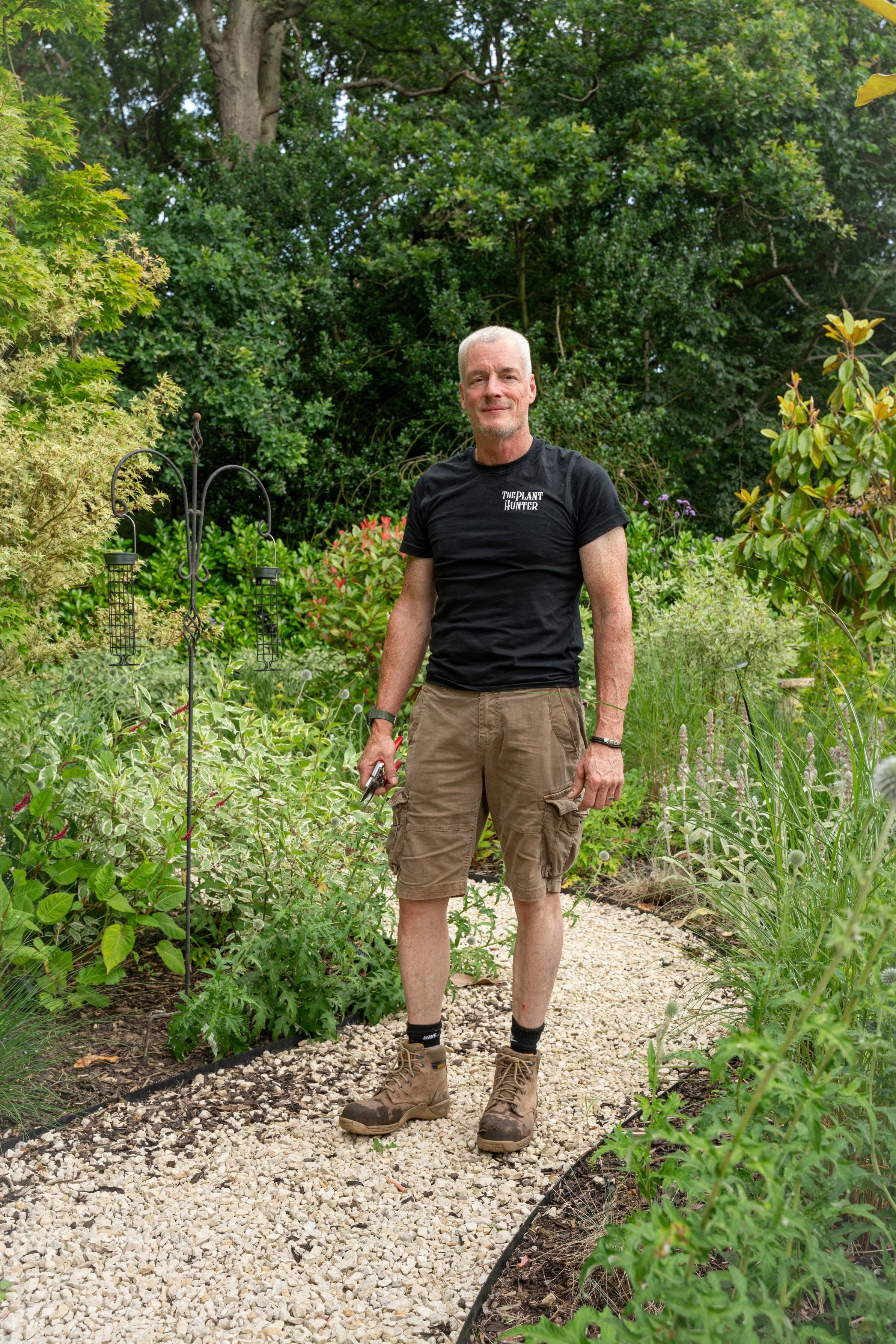
Paul Studholme is the garden designer behind The Plant Hunter, based in East Horsley, Surrey. In more than 30 years he has restored the two-acre Medicine Garden in Cobham, won a Countryside Alliance Award, and been invited to consult at RHS Bridgewater. He has spent his working life learning how plants behave in Surrey's clay, chalk and sand.
Who this is for: anyone weighing up whether Paul is the right designer for their garden, and wanting to know the experience behind the practice.


A lifetime around plants
Paul Studholme has been interested in plants since he was 12. He used to make regular trips to RHS Garden Wisley, spending most of the time in the glasshouses, not looking for anything specific, just being around plants. That pull never left him.
He trained at Merrist Wood College, completing a Diploma in Horticulture over three years, with a middle year at a commercial nursery in plant production. Working at scale and understanding propagation gave him a different education from anything he could have got in a classroom. Seeing how plants behave in large quantities, how they fail and recover, and how much the conditions matter, stayed with him.
From there he moved into garden maintenance, then gradually into design, spending several years working alongside an established designer and taking the lead on all the planting while others handled structure. When he eventually took over the design work entirely, the foundation was already there: he had spent years watching how gardens developed, where things went wrong, and what made planting actually work rather than just look acceptable on the day it was installed.
How Paul sees a garden
The first thing Paul notices in any garden is the layout: whether it has a coherent shape, or whether it is just a series of areas that have accumulated over the years without ever being properly resolved.
Most gardens that do not work have the same underlying problem. The shapes jar. Straight lines meet random curves. There is a patio too small to actually use, or a lawn surrounded by narrow beds that have never had room to do anything. Getting the structure right is where the design work starts.
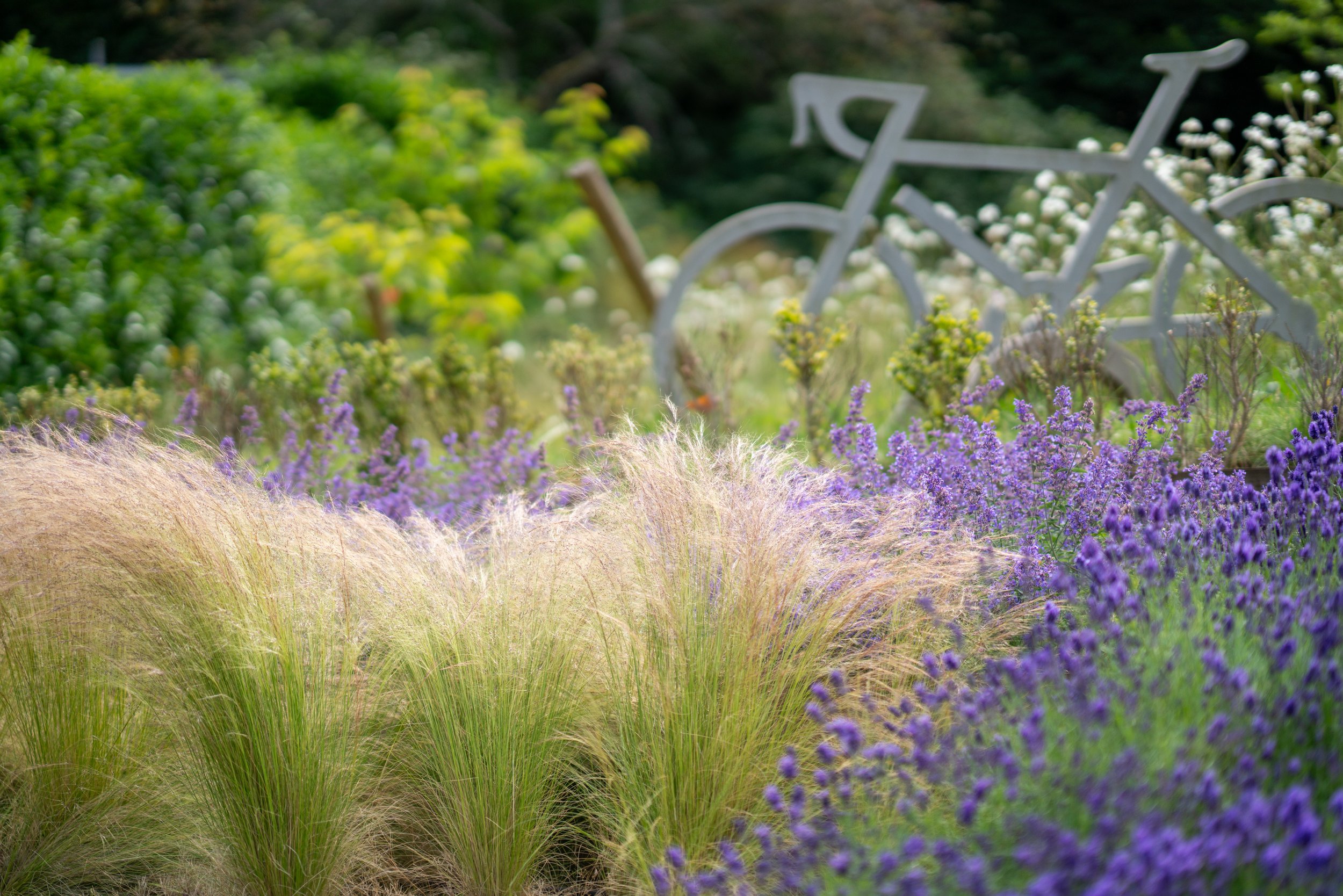
After that it is the planting. Paul is interested in what a garden looks like in February as much as July. He spaces plants for how they will grow in five years, not for how they look on the day they go in. He knows which plants hold their shape through a Surrey winter, which ground cover closes over properly, and which grasses earn their space season after season rather than looking thin by year two.
What interests him least in modern garden design is the reliance on structure alone. Clipped hedges and hard landscaping are fine as a framework, but without planting that has genuine character the garden has nothing to carry it through the year. The plants are not decoration. They are the point.
Paul creates gardens designed to improve with age, not just look good on completion day.
The Medicine Garden
The project people ask about most is the Medicine Garden.
In 2007, Paul spotted a derelict Victorian walled kitchen garden in Cobham going to let. He had known about the site for years; there had been a small nursery there, and even then, buried under decades of ivy, it was clearly something worth saving.
Four years of clearing, restoring and building later, the result was a two-acre walled garden opened to the public for the first time. It ran as a community space for 12 years: a cafe terrace, outdoor cinema, regular events, and a planting programme that drew people who had never previously been interested in gardens. It became a well-known local landmark and eventually won a Countryside Alliance Award for its role as a community hub.
The Medicine Garden's reputation led to an invitation from the Royal Horticultural Society to consult on the RHS Garden Bridgewater in Salford before the rebuild began. Paul was asked for his perspective on the planting approach, drawing on what he had learned over four years of working on the Cobham site. More recently he was invited to help plant at the RHS peat-free garden at Hampton Court Flower Show.

Recognition
When The Plant Hunter were BALI members, early in the practice's life, they won three awards: Best Newcomer, Best Garden up to £14,000, and Best Garden over £100,000. The approach those awards recognised, planting-led gardens built to last, still runs through every project.
Paul contributes regularly to Livingetc magazine, with published features on garden privacy, fences, decking and maximalist gardens.
The work now
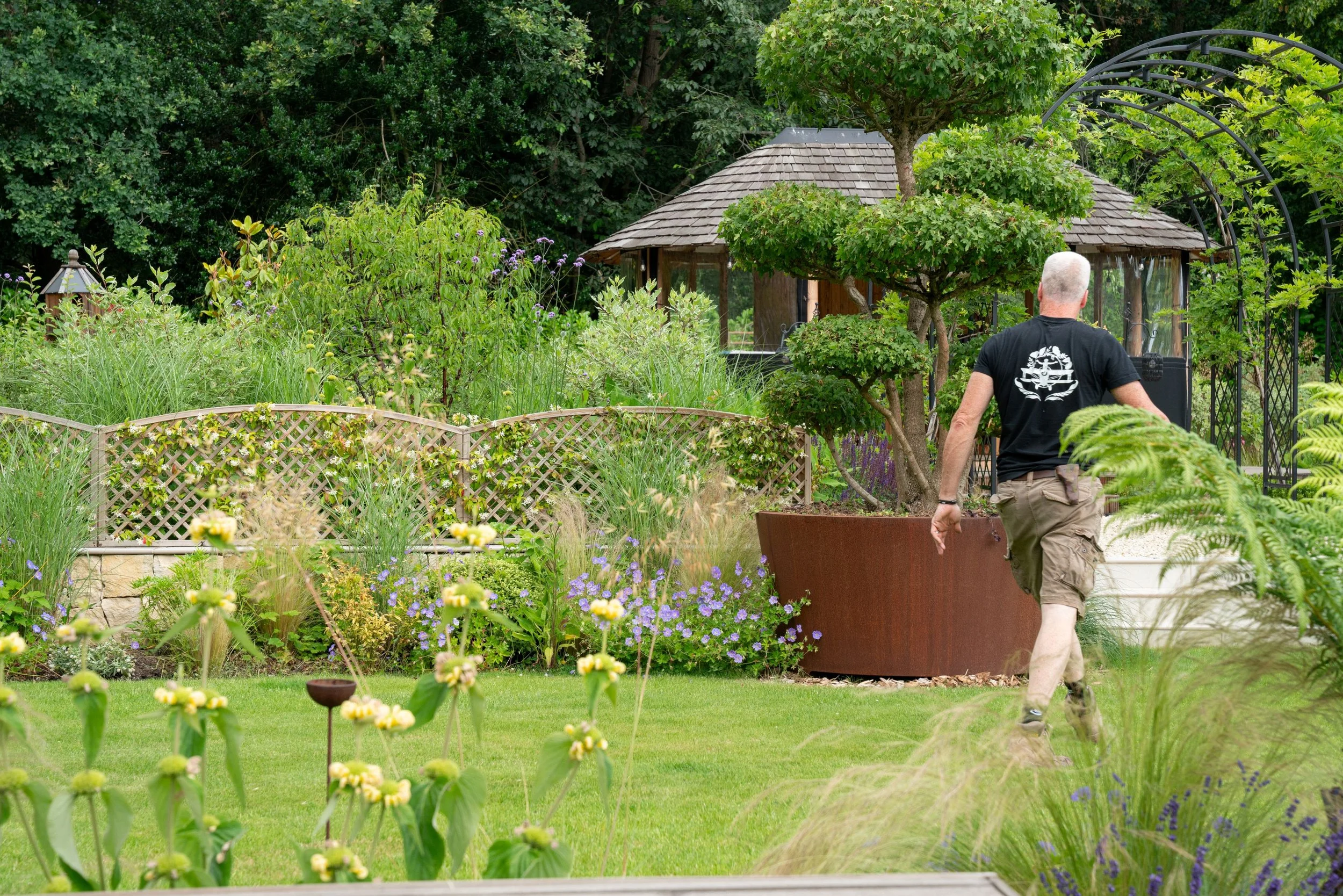
Paul works as a garden designer across Surrey, primarily around East Horsley, Cobham, Weybridge, Virginia Water and Guildford. He also takes on commercial projects further afield, including living wall installations in Twickenham and Richmond.
The work he returns to most often sits at two ends of the same spectrum: structured, formal gardens with an Italian influence, and loose, naturalistic planting that shifts through the seasons. His most-used plants include Calamagrostis x acutiflora 'Karl Foerster', Nepeta, Betula utilis, Hydrangea paniculata 'Limelight', and Prunus serrula for the best bark of any tree in a Surrey garden.
He is generally less interested in gardens that rely on expensive materials than in gardens where the planting genuinely improves with age. That is the kind of work that stays interesting.
Get in touch
To discuss your garden, call Paul on 07774 259570 or email paul@theplanthunter.garden